Category: Running Seer

  • Real talk: In an AI forward company who stays and who goes?

    Real talk: In an AI forward company who stays and who goes?

    “When I stop being on your ass, that is when you know I’ve given up on you, because I know the ceiling to your potential”

    –Greg Luzinski (Former Philadelphia Philie) to 16yo Wil


    In high school I had a baseball coach who used to be a star on the Phillies, Greg Luzinski, better known as, “The Bull,” in Philly circles. His son Ryan went to my high school and I was on the team.

    One day, “The Bull” took me into the cages and said, let’s work on the “curveball.” Here I was. Being trained by a PRO, teaching me to hit the curve!

    After 2 long sessions, he stopped spending that time, and it was the right call. I struggled to “hang in” on the curve. I was a curveball hitting “laggard”.

    AI is the curveball for many of us, and I want to build the “Greg Luzinski” of agencies. Many of us are business owners of “pre-ai” companies, and we have to ask ourselves one question…


    “What is my sorry but you can’t work here anymore cutoff for my AI laggards?”


    Four guys got drafted from that team, in large part their lives were made better because my coach got the time back to coach them by reducing his time spent on me.

    Agency leaders are secretly talking about AI laggards, and how to manage them, but almost nobody’s talking about it publicly with how to think about it.

    In WRITER’s survey, 75% of executives say their AI strategy is more for show than real internal guidance. Same survey: 60% plan to lay off employees who can’t or won’t use AI.

    Read those two numbers together. A lot of leaders are planning consequences for a standard they never actually set.

    So here’s my argument: before you hold people accountable for AI, make sure you’ve earned the right to.

    That means setting a clear standard, investing in getting people there, and measuring contribution by value, not volume. Then be honest about the consequences.

    The first three are on you. Only the fourth is on them.


    1. Did your managers ever SET the standard?

    Here’s a test I love, from the book How Google Works:

    Are there people on your team who, if they told you they were leaving, you would not fight hard to keep?

    If there are, ask the harder question: did anyone ever tell them what it takes to be someone you’d fight for?

    Chadd Wright, former Navy SEAL, from his creed: “Professionals have standards.” In his talk, he adds that you have to have a standard to measure your actions against.

    Professionals Have Standards

    I’m extremely AI-forward as a CEO. That’s pretty obvious.

    I don’t run the business though, so this shows up in how I advise my leaders: have you set a standard for the behaviors required to be on your team?


    Can your team repeat your standards if I walk by them in a hall and ask?


    When I ran teams, being on my team meant certain things: we volunteered, we wrote what we thought and shared it publicly, and we looked for people who were down to challenge the status quo, and a bunch of other stuff.

    Did it create a ton of chaos? Absolutely.

    It also built a brand as a company that innovates, and we’re still reaping the benefits today.

    CONSISTENCY: Have I said it long enough?

    My earliest AI posts are three years old, saying “this is it.” I said the same in our all-hands. Go back through your all-hands and team comms, and run prompts to see if you’ve been consistent for months.

    Example: earlier this year I wrote that I’ll never again ask a web analyst to pull Google Analytics for me, I will ask them to help poke holes in my assumptions, that’s the value.

    Steal this prompt!

    Run this on your own all-hands transcripts: “List every time I talked about AI in an all-hands, oldest to newest, with my exact words. Flag when I first said AI was a big deal, when I set expectations, when I offered help, and any all-hands where I didn’t mention AI at all.”


    Is your team “killing it” today on a task list made 3 years ago?


    I’ve written a lot about the stages of AI maturity. Outlining the stages is one thing. Saying who actually stays and who goes based on them is another.

    Here are 3 posts on marketing AI maturity:

    Three posts on marketing AI maturity

    2. Look within FIRST! You might be the problem!

    I was taught in 5th grade when you point fingers at others to blame them, that is one finger pointing at them, and 3 fingers back at you.

    Spend 3x as long looking at yourself before blaming others. This section is for you to point at yourself, that is where learning and growth comes from anyway.

    Looking internal: Take something you wanted to be better at, has blaming someone else ever miraculously made you better at that thing?

    One finger pointing out, three pointing back

    Peter Drucker, in The Effective Executive said this: “If you want the average performance of those around you to go up, you must first improve your own performance.”

    • PATIENCE: Have I given people time to get there? I might be extremely AI-forward, but I need the patience to let others catch up. How many months or years can someone be in your company before you decide to fire them for being disconnected from the vision?
      • My job is purely innovation: no internal meetings, kickoffs or QBRs. Compare the time you have for AI research vs the time your people have. Maybe them being heads down is the goal, so you can be freed up. Are you sweating it and working a 70 hour week that feels like 40 because you “LOVE” this moment? Well maybe they are working 40 and it feels like 70. You could be comparing apples to bananas.
    • TRAINING: Did we invest in training. If so, how much, what % of my revenue is on training, what % of their hours? A lot of us learned by trial and error. Not everybody learns that way, and you’ve got to respect it.
      • Some people learn at a different pace and are still bought in. Did you buy the trainings? We now have people building agents in their first week at Seer as part of onboarding. We give them the week “off” with the job to be done is to spend week 1 just getting up on AI.
    • TEACHING: Did I hire AI forward people who love helping others become AI forward? People need peers at every level who are AI-forward AND education-forward. Without them, you may have brilliant people building scalable agents and skills who just don’t love helping others level up.
      • Stripe created a “Forward Deployed AI Accelerator” role. One AI-native person per cohort of 20 marketers, coaching each one until they’re self-sufficient. That might be the investment you need.
    • SHARING: Is learning in public part of the culture? Our AI Slack thread has thousands of messages, people bantering, testing, sharing, etc. Our Monday pulse check asks “what are you proud of from last week?” it has run for seven or eight years, and two or three years ago we added “how are you using AI?” Give people more than one place to share their journey, but don’t blindly accept “trust me, it’s happening in places you can’t see.”
    • TOOLS: Did I give them what they need? Robin Ross has a framework I love: Mindset, Skillset, Dataset, Toolset.
      • Mindset: what does a post-AI person think that a pre-AI person doesn’t, how are you cultivating more people with that mindset in your company today?
      • Skillset: what responsibility do we have to get them the skills? Covered this above in training
      • Dataset: have we done the IT work so they can give clients truly unique consulting, in a world where everyone have the same data? Do we make our data available easily, reliably, and consistently? Do we blend our data in ways that are unique, are we trying to build unique data to help our consultants win?
      • Toolset: are we investing to make these tools accessible, if someone wants a subscription to something, how easy is it for them to get it? Do you have a fund for each employee where they can get access on their own, right when they are having the problem? Or will it be a 2 month process?
    • My TIME: Can they get my time to build? I told the team I’m always available for “build” meetings. Anything else, I’m a lot harder to get. That signals where my time goes, have you signaled where your time is best spent to your team?
      • Receipt: in January 2025, I cancelled almost all my non-build 1:1s. Non-build time moved to two Fridays a month, since then I got more flexible, but announcing that allowed people to know where my time shofted and how to get it.

    None of this is about getting everything right. This is about signaling long enough and consistently enough that when you have tough conversations with someone about being behind, you have done the work to look at yourself, you need to feel like you gave them more than enough chances to show they were leaned into where your say your company is going.


    3. Then go find who’s adding VALUE, not volume

    “Check yo self before you riggity wreck yo self. “

    You’ve given yourself the tough self talk above, if there’s a ton of holes in your accountability mirror, you need patience and you need to fix your stuff.

    Once you’ve checked yourself and feel good… Proceed.

    Go looking for Leaders and Laggards.

    Leaders are able to predict the job they’ll need in the future and they are doing real stuff today, to help your company be prepared for that future, have you set that as a standard?


    EXPONENTIAL value is driven by AI forward leaders. Linear value is driven by laggards.


    When I look at AI leaders versus AI laggards, the leaders contribute in ways that create exponential value for the organization.

    I recorded a video for my team in july on the difference between an AI-forward person and one who isn’t, and what it does to the business and to our clients. Here’s how I explained it.

    Exponential value from AI-forward leaders vs linear value from laggards

    Two people – Same level – Same smarts: Different Outcomes for the company – 2 MILLION dollars worth!

    Picture two people at the exact same level. Same smarts, same client retention. Person A does a great job for their clients but rarely shares.

    Imposter syndrome, doesn’t think their stuff is worthy, whatever it is, their ideas never get a chance to inspire anyone.

    Person B (Leader Lucy) puts their half-baked shit out there. AI leaders invite scrutiny; AI laggards (Lagging Linus) stay quiet so they “don’t look stupid.” I’ve had everyone from interns to absolute geniuses make my stuff better because I put it out there.

    Then it ripples, Leader Lucy posts, 3 people see it and make it better. 10 more people read it, and some straight up copy Lucy’s transcript and turn it into their own version. 4 use it on their clients. 2 go hard and rebuild it as a skill that fires for every client.

    Linus has smarts but they stay trapped in 5 clients, linearly. Lucy’s idea reached 25 people, plus every client that skill touches. None of that happens if Lucy doesn’t share.

    Person A vs Person B: how one shared idea ripples

    And because Lucy keeps building, she carries MORE clients in the same hours.

    Linus waits for the company to fix or build,

    Lucy is like: “I’m automating the parts of my role that don’t create the most value, so I can take on another two clients right now.” At $100K an account, 5 clients vs. 7 is a very different person.

    It’s NOT about saving time. If your value from AI is saving time, somebody might as well send the work to the cheapest outsource provider.


    The biggest value comes from doing things we could never do before.


    The math (and the asset)

    Person A vs Person B: what the gap is worth

    All of that assumes what they put out isn’t workslop, and that people actually take it, use it, improve it and use it for their clients. If so, the economics of those two people are just different.

    Judging laggards volume vs value

    As a leader, you have to be really sharp at assessing value vs. volume. Volume is the loudmouth who posts everything they think, and none of it gets implemented.

    It’s your job to not overvalue the talkers

    The top post on our website was written by Aichlee Bushnell (great co-worker, strong endorsement, hire her). It was our Screaming Frog guide, it was the ONLY post she wrote in 2.5-3 years of being at Seer, it created 10 more years of value.

    That’s a lot more value than someone who might have written 30 posts in the same time.

    3 great reads:


    AI Leaders moat is their IMAGINATION, where does imagination come from and is your org an imagination machine?


    Here’s a question I’d ask in an interview today, imagine that three years from now, someone open-sources a tool that writes all your [titles and meta descriptions], does all your [on-page] and [technical SEO], and gives you every recommendation to [speed up the site].

    As an SEO or content marketer, what would you do to look into that vision and help the client succeed?

    Ask your current employees too. It’s a very hard question, and the answer shows you how they think.

    AI-forward people have already started. They’ve freed up their brains, and in a world where information is now table stakes, they need to create new ways to build value.


    Who you spend time with impacts what you can imagine, check Steve Jobs


    Steve Jobs is easily one of the most innovative people of our time. When you backtrack how he met the people around him, he was aggressive about who he got to spend time with. That expanded his imagination…

    • Bill Hewlett. At 12, Jobs found him in the phone book and called his home. That one call got him parts and a summer job at HP.
    • Regis McKenna. Jobs saw an Intel ad he loved, called Intel to find out who made it, then called McKenna’s office several times a day until he got the meeting. McKenna shaped Apple’s early positioning.
    • Robert Noyce. Jobs called him and showed up at his house uninvited. Noyce took his late-night calls in the early ’80s.
    • Bill Campbell. Long walks most weekends for years. A 28-year friendship.
    • Andy Grove. Jobs called him for advice for decades. In 1997, when Jobs was dithering about going back to Apple, Grove told him he didn’t give a shit about Apple and to make up his mind.
    • Kobun Chino Otogawa, a Zen teacher, and Robert Friedland, whom he met selling a typewriter at Reed.

    Look at the diversity of his circle, too: a retired Intel marketer, a Zen teacher, a PR guy, chip founders and a commune leader.

    If AI becomes the thing you spend the most time with, it’s the most average company you can keep, because it’s trained on consensus.

    AI can execute what you imagine. The humans around you shape what you imagine in the first place.

    So being intentional about your human circle matters more now, not less.

    What are you intentionally doing to put people who help you imagine into your circle? You calling them 10 times?

    Laggards don’t expand your imagination the way leaders do.

    We are moving from a world of information asymmetry to a world of inspiration asymmetry.


    4. NOW be honest about what happens to your laggards

    If you’ve done the first three, you’ve earned the right to this part. Don’t skip it.

    “You can’t want to feed someone’s family more than they do.” It was one of my biggest learnings on AI Laggards.

    I think many agency leaders are like, this thing is going to change your future employment FOREVER, how am I stressing it this much and you are out here Kanye shoulder shruggin’?

    Consulting Agencies – Match your CLIENTS AI readiness to your people needs

    Not every client can take advantage of AI-forward people, whether it is vision, legal, or other hurdles.

    Index every client on two things: how AI-savvy they are, and how willing they are to let your team use AI.

    If you put your AI-forward people on laggard clients, or on clients who won’t sign off on your most innovative work, you’ve built a recipe for frustration for your best adopters.

    If 30% of your portfolio can’t take full advantage of AI-forward people, you can technically get away with some really solid laggards on your team, and give them more time to level up, technically; these are your A & B players pre-AI, they are still solid.


    High performing AI laggards should have an expiration date that is attached to the size of your AI laggard client revenue


    If your portfolio shifts, your tolerance for laggards must shift, or you’ve just inherited a new headache: frustrated clients.

    Benchmark client savviness quarterly. I’ve seen lower AI savvy POC’s lose their jobs when an AI-forward exec comes in at the top. Suddenly you’ve got a very AI-forward leader brought in to make change – and your team is an AI laggard, you have to get in front of that – or lose the revenue. Or end up in a LOT of meetings repairing problems you didn’t get in front of.

    I told my team this in an all-hands years ago:


    The pool of clients who won’t let you use AI isn’t growing, it is ONLY shrinking. Your career prospects will shrink with them too.


    I was volunteering with the team at a boston non profit, more than words, helping young people come up and improve their lives, and I saw this sign…

    Flip-board sign at More Than Words in Boston

    “Your salary is the company’s subscription fee of you”


    What happens to the “subscription fee” of laggards in your organization?

    • Do they stay?
    • Do they get told they’re behind?
    • Do they stay and get no raises?
    • Do they get raises like everyone else?
    • Would we seek to replace them?
    • Then the million dollar question… for how long?


    Laggards don’t get calls from 3rd WORLD JAIL CELLS


    George Mack has a thought experiment in his piece on high agency: you’re stuck in a third-world jail cell and you get one phone call. Who do you call?

    High agency: who do you call from a jail cell

    You’re handing someone a problem that seems impossible, with no guidebook, and you’re still betting they’ll find a way out. Who is that person for you?

    Will Critchlow, asked me a version of this. And then he flipped it


    For how many people do you think YOU are that phone call from a 3rd world jail cell, cause for your clients, AI is that moment, are they calling YOU?


    64% of CEOs fear losing their job if they fail to lead the AI transition

    64% of CEOs fear they could lose their job if they fail to lead their organization through the AI transition. That is their version of a third-world jail cell. Would they call you?


    Agency Owners, you got a shot here…

    It’s funny. I’ve talked to so many agency owners who feel mired down with people in their company who aren’t keeping up with the times. A lot of those agency owners are burnt out. You are choosing to keep them in your company.

    And they’re worried about the AI-native agency coming for them and their people. Rightfully so. Many of them are behind, and many of their people are too.

    But time gives you something extremely valuable that the AI-native agency you’re so worried about doesn’t have yet: a brand.

    If you know anything about humans, humans love brands as shortcuts. And that AI-native company isn’t going to show up overnight in AI answers, because AI is a lot like humans in the way it associates brands. This is why we’re seeing brands in query fan-outs.

    Lily Ray dropped this gem:

    A solo developer, can vibe-code a brilliant feature in a weekend, but incumbents already own the contracts and relationships. It’s the same dynamic for agencies.

    Lily Ray post: incumbents own the contracts and relationships

    So I hope you as an agency owner or a consulting shop, got this far, you have assets, your brand, your relationships, your trust in your industry that the others don’t, but they are gaining – fast.

    I’ve seen it in my own industry, Profound has done an amazing job of being everywhere, and getting trust in a lot of spaces. The question is will you leverage your years of experience, trust and relationship building to match the “AI natives” or will you let them eat your lunch?

    See you on the other side, cause I’m going out swinging!!!

  • I flew about 70,059 mi last year. Who am I to talk about AI’s impact on the environment?

    I flew about 70,059 mi last year. Who am I to talk about AI’s impact on the environment?

    Shout out to Dan Mall. I asked him last week, to shoot holes through some of my thoughts on the argument about the environmental impact of AI vs our personal usage of things that are bad for the environment.

    I whined “Isn’t it interesting how we want ChatGPT to “change” a company we don’t control. Yet we’ll swear by almond milk and eat hamburgers without thinking twice.”

    He said:

    “You need to be more upfront about what you actually think about AI and the environment, exact quote “you are the dang leader, tell the team what is in bounds and out of bounds”.

    I got tired of the argument, so I went and looked at myself first

    We’re a B-Corp. So my company should be asking me tough questions as the environment is a stakeholder. But something about it kept bugging me, and it took me a while to name it.

    We hold AI to a standard of scrutiny we do not hold ourselves to.

    Not one person in the company has ever said, hey wil, I care so much about the environment that I want you to show me your flights and your impact on the environment and discuss what we’re going to do about that.

    Most real change starts with looking at yourself, and if I’m going to ask people to bring me data, I’d better show up with my fucking own.

    Have you ever compared your AI usage vs your travel impact? It’s brutal.

    01   Start with me

    I flew 70k miles last year.
    Mostly in business class.

    Forty-one segments between August 2025 and August 2026 — roughly 2.8 times around the Earth. Brazil twice, Munich, London, Mexico City, Oaxaca, and a dozen domestic hops. (Claude analyzed my calendar this could be off).

    43.6 t

    CO₂e — one year of my flying

    22.6 t

    If I’d flown economy the whole way. This is the floor.

    43.6 t

    Adjusted for the seats I actually sat in.

    87.1 t

    Including contrails and NOx at altitude,

    14–16 t

    The average American’s footprint, all sources. My flying alone is about triple it.

    Now the AI number, done honestly

    There’s a number floating around that says a median AI prompt uses about 0.24 watt-hours. It’s a real measured figure from Google.

    I modeled the expensive version: the IEA’s 2026 estimate for an agentic request with reasoning, which is about 50 Wh a pop — roughly 200× the chatbot median.

    Two hundred heavy reasoning runs a day. Every single day. For a year. That’s about 1,350 kg of CO₂e.

    Which is 3.1% of my flying.

    To offset one year of my flying with AI, I’d have to kick off a heavy reasoning run every 4.5 seconds — every working second of every working day, for a full year.

    AI usage is growing fast, which is exactly why it’s fair to examine todays multiples by this aggressive growth rate. But my personal AI use, run harder than almost anyone at Seer runs it, is a rounding error next to how much I fly.

    Right-size your model usage.

    Sonny recently posted internally that using a more efficient model could have an impact on our usage and I was like we should do that.

    What if I used a smaller model?

    Shifting 20% of my agentic work from Opus to Haiku saves 264 kg a year. That’s slightly more than my July round trip to Boston.

    Almonds, hamburgers, golf courses, and pools

    This is where my head really went, data, always and it started with water, ok if we care so much about water usage….

    One almond takes about 3.2 liters of water to grow.

    One quarter-pound beef burger: about 1,700 liters.

    One simple AI prompt: 0.26 milliliters. Five drops.

    Then I went to Arizona, because Arizona is a desert and they got tons of golf courses and pools (used deep research).

    UseAnnual watervs. data centers
    All Arizona data centers (2025)0.9 billion gal
    ~505,000 residential pools~8.1 billion gal~9×
    Golf courses, Phoenix AMA alone (174 courses)~32.4 billion gal~36×
    Pools + golf combined~40.5 billion gal~45×
    Agriculture, statewide>70% of all AZ water~1,700×

    Statewide, about 74% of Arizona golf water is potable. In the Phoenix AMA only 21% is reclaimed. Phoenix golf on drinking water alone is roughly 28× every data center in the state.

    Don’t you take away my pool…

    Arizona has around 505,000 residential pools — one for every 13 residents, more per capita than any state in the country.

    We built half a million private pools in a desert without a single public meeting about it. Nobody called that an environmental crisis. Something else is at play here, AI is striking a chord that I think all of us need to dig in on. Why THIS and never THAT?

    Wil, what is “in bounds” at Seer?

    Everything above is research. This next part is the thing Dan wouldn’t let me leave out, and it’s the reason this post exists.

    My number one job is keeping people employed. That’s it. That is the top of my list and nothing is close to it.

    There are roughly 180 people whose mortgages and tuition payments and health insurance run through this company.

    We’re operating in a market where organic traffic is falling off a cliff and the entire mechanism by which people discover brands is being rewritten in real time.

    So the environment sits lower on my priority list than winning as a company. Not because it isn’t something I want to work on and fix. Because I can’t make it my driving force and still do the first job.

    I’d rather say that plainly than let people assume I secretly hold it as priority one and just never act on it. Dan’s point was that my team deserves to know the real order, even if they don’t like it.

    So here’s exactly what I will and won’t do as of today.

    What I believe

    • We hold AI to a scrutiny standard we don’t apply to our own choices. Business-class flights, vacations, pools, dogs, burgers, almond milk — all bigger, all mostly unquestioned.
    • AI’s footprint is growing fast, so it’s fair to examine. What bothers me is examining it while ignoring our own.
    • Data center water use in Arizona is genuinely a problem. Golf courses are a much bigger one and get almost zero protest.
    • Most change starts with looking at yourself before you point at anybody else.
    • Right-sizing models from Opus to Haiku where it fits is worth doing — real savings, no loss of capability. Just don’t sell it as a climate program.
    • Individual, voluntary evals are the actual lever. Taylor moved a chunk of work from reasoning calls to static SQL queries — had the idea, tested it, proved it, shipped it, without being asked. That’s the model.

    What I’m willing to do

    • Fund an intern to work on this, on Seer’s time and with Seer’s money.
    • Share Seer’s own data publicly and with government orgs so other companies can learn from what we find.
    • Use my connections to push this work forward.
    • Build the internal infrastructure so people can run real evals – Haiku vs. Opus, local models, etc
    • Back anyone who wants to spend their spare pockets of time on efficient model environmental impact evals.
    • Support anybody who tests an idea on their own initiative and brings the data back.

    What I’m not willing to do

    • Personally implement other people’s ideas. I care enough to look at myself, do the research, fund interns and test my own usage. If you got an idea, you gotta care enough to work with me but not assume I’m going to do it.
    • Carve out extra paid time specifically for this work (outside of the intern)
    • Change my travel
    • Let this become the priority. The priority is survive and thrive at this time, so we can live into our values – win for our clients, so we can win for our co-workers, so we can win for our community. In that order.

    FYI this post is about 40% written by AI, as it was research heavy. I spent 3 hours talking to Claude, sharing my ideas getting pushback, pushing it back, reading it outputs. Then I recorded a video for the team of my thoughts, and had claude read that transcript + all of our chats and help write a draft, and with my new wordpress MCP connector it pushed the draft right in.

    The job to be done with any post is to think, and share not to “avoid em dashes”. So If you seen an em dash, in the immortal words of DMX…get at me dog, I’m ready.


    Method. Flights: 41 calendar segments, Aug 2025 – Aug 2026, great-circle distances, 0.255 kg CO₂/passenger-km under 1,500 km and 0.195 above, business multiplier 2.5× long-haul and 1.5× short-haul based on booked seats. AI: IEA 2026 estimates of 50 Wh for an agentic request with reasoning and 1.1 Wh for a standard agent request; 0.37 kg CO₂e/kWh US average grid. Excludes training amortization, device energy, and non-agentic chat — all of which push the AI number up, not down. One acre-foot = 325,851 gallons.

    Sources. IEA, Key Questions on Energy and AI (2026) · Our World in Data / Hannah Ritchie (2026) · Google Cloud, AI inference measurement paper (2025) · Bluefield Research via Circle of Blue · Ceres via Grist · ADWR and University of Arizona golf water studies · WRRC Phoenix AMA data · Arizona State Law Journal on allotment overages · KOLD Fact Finders on per-person pool water · US Bureau of Reclamation 2026 Level 1 Shortage declaration.

  • The tech stack I use to keep track of my promises

    The tech stack I use to keep track of my promises


    “When you make a promise you give hope, when you follow through you build trust.”

    That was the quote from the speed of trust that nailed it for me, I was sick of asking for “forgiveness” when my inbox was so full that I couldn’t see an email in my inbox anymore.

    It wasn’t an email problem, it was a me problem. I’ve always had this problem. I try to help as many people as I can, which is a good thing, but without a system to make sure I follow through, I’m actually just disappointing too many people.

    Trust can be diminished in an instant, after years of building it up, it is fragile.

    Too many of us say: “If I just had an AI meeting tool to keep track of all my to-do’s” but that isn’t really a solve for missing to-do’s and deadlines.

    Your comfort or discomfort with blowing a deadline, or missing an email that isn’t about tech, that is about you.

    I have tried 10+ different systems to be better at managing promises / deadlines. The thing that finally landed me on a good system, was that I felt missed deadlines were broken promises and unforced withdrawals from the “trust bank” with people, so I had no choice but to keep working at it.

    I had tablets (for email only), meeting schedulers, AI tools, EA’s, Zapiers, Makes, to-do lists, google tasks, reminders, inbox pause tools, folder systems, you name it I tried it.

    Thankfully today I have a system that helps me be stronger than ever, but it was the desire to get better that made me better, the desire to avoid disappointing people once again and once again.

    Is the “trust loss” of a broken promise worth setting up the Free system.

    • Clockify — FREE
    • Email Folders — FREE
    • Followupthen -FREE (up to 50) — $4/mo
    • Slack + Zapier — FREE (until you get to too many zaps /month)
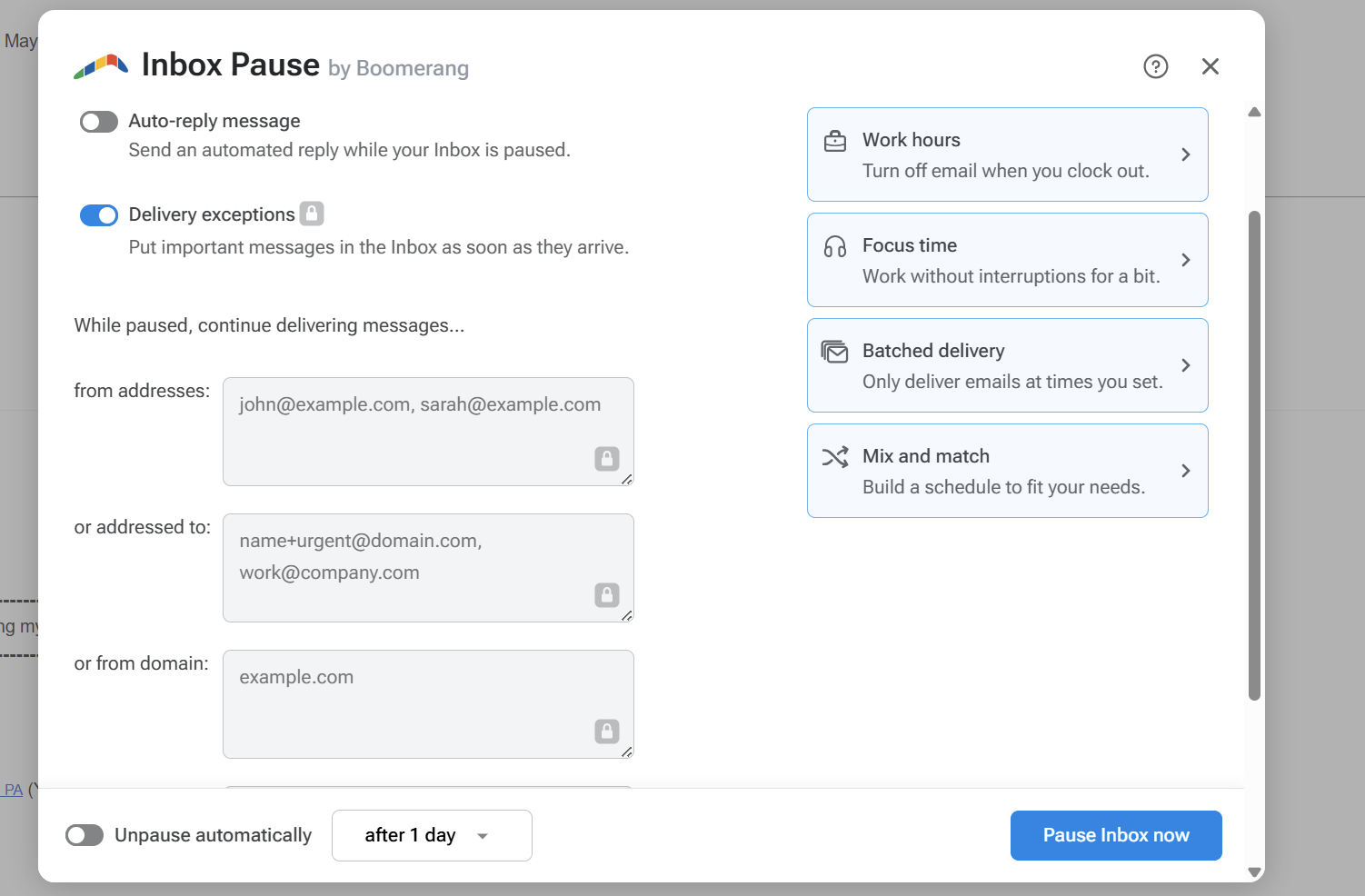
    • Inbox pause — FREE
    • Exec Assistant — NOT FREE 🙂

    Pause Inbox

    I work out of my inbox, so I must stop the flow of what comes in (I use inbox pause for that). I peek into my paused inbox every once in a while throughout the day but you can set up all kinds of rules to make sure the right things get through.

    Clockify

    I track my time sorting email, differently than answering email

    I do subscribe to the OHIO method to best I can, only hit it once. I try to file it or answer it.

    I also found in my weekly hours reviews that I had these big blocks of “email” that is where folders came into play.

    Email Folders

    For good or bad I work linearly, so I must put my folders in number order so my folder names sound like:

    1 — Sales

    1 — Client Work

    2 — Innnovation

    2 — Sales

    3–HR

    Putting them in number order means when I go to work linearly, there is no confusion about what I should do… work the 1’s until they are empty. By having a folder system I can change my hours from marketing, to sales, to innovation, to charity in my time tracker, which helps me do analyses like this with more precision.

    Slack + Zapier

    We use slack a lot here, and that can get messy in keeping track of promises so I set up a Zapier that if I hit “save” it automatically pushes into my inbox, where I have a system, as you are reading, to keep track of my promises. Slack is very hard for me to manage all the promises in, so that is one key thing…get all the promises in ONE place.

    Followupthen

    Ever have an email staring at you, taking up space in yoiur inbox and pushing other emails to “page 2” — I’m telling you, page 2 is where promises go to be forgotten!

    Folowupthen is so much better than Google’s reminders and it crushes on mobile in your regular gmail app, just add the FUTs to your address book, it is so much faster. Every Jan1, every email receipt for donations come back into my inbox for instance.

    Repeat followupthen’s are my jam: every20hours@, every3weeks@ or everyfriday8a@ or every february@ they allow you delete something you just can’t get to, knowing it won’t be forgotten because it is coming back in. For some reason my brain works better if I let that happen vs filing them away all the time.

    The autocomplete is so helpful!!

    Executive Assistant

    My EA has to have full access to my inbox, that allows her to go into my folders and align us on our daily standups… She’ll say things like

    “Wil, this email has been sitting in 1 — Client work for 2 days, yet I saw you clock 2 hours on team shout outs, I need you to refocus, move it to another priority, etc etc.”

    Now, not everyone can have an accountability partner like that, but you can use AI to do some of it, espcialy with tools like Open AI’s Operator. You could technically try having it look at your hours in clockify or use zapier to dump your hours somewhere and then you could use operator to go into your inbox and look for certain folders (I would recommend you give it the exact URL to each of your high priority folders).

  • Getting better service makes me want to be a better servant (to my clients)

    Getting better service makes me want to be a better servant (to my clients)


    As leaders, we often find ourselves in the role of helper and problem-solver. It’s part of our job to anticipate needs, clear roadblocks, and guide our teams towards success.

    But how often do we experience that level of care and foresight directed towards us?

    Well I just felt what it felt like … and it felt so good that it made me want to be a better leader and level up for my customers. Maybe as leaders once in a while we should feel what it feels like to have someone be ahead of us as inspiration on how we can be that for our clients, but you have to FEEL it, cause if you treat yourself to an amazing hotel, where the team is THIS good, you can’t help but ask yourself… How can I help steer my business in a way where we aspire to that level of service, that kind of service that makes a client exhale and their shoulders drop because they think of your company as a “we got this” team vs a “what do you want us to do” team.

    An unnamed CEO (unless they choose to let me change this), once said to me…you gave me a gift Wil, the gift of your time, advice, etc…and they went on to say that as a CEO every email is someone who wants something from us, every refresh of the inbox is likely to result in an ask, someone taking or needing something from me, that can be exhausting. While I don’t 100% feel that way, I do get it and I empathize.

    During a recent stay at Kasbah Tamadot in Morocco (this is about to be the longest hotel review you’ve ever seen) I had this reflection, I recorded every little thing they did so I could vivdly wirte this post because every day,multiple times a day I was blown away and I knew I’d forget these stories. I wanted to write this post to give them a shout out, but also to give you a feel on the lengths they went and how it gave me a new gear to aspire to. I’ve been a sucker for great service all my life, a sucker for people who lighten my load, and love books like this one.

    I had a realization: I’ve rarely, if ever, felt what it’s like to have everyone at a hotel so dialed in to my preferences that they can predict what I and my family might want and they just do it, no questions, they just do it because what they know is the last thing I want on vacation is making more decisions.

    They functioned as a team, you could just tell they knew what the right thing to do was for guests, no hesitation, no nothing. That reminded me of the asset of longevity as a leadership team (I can imagine there’s some liability in there too, but its definitely more of an asset to me). Almost every one of my execs has been with Seer over 10 years.

    They planned a scavenger hunt for my kid’s birthday

    A perfect example of this was when I mentioned wanting to do a scavenger hunt with my kids (thanks Ellie) on their birthday in the Atlas Mountains.

    With just that single request, they handled everything.

    They got the drivers to take us, they found local people to assist in the planning, our guide brought his kids along so my kids could play tag, hide and seek, and play games with his kids, they contacted an ex pat to help figure out what would be educational and fun (we learned how to build baskets with a the guide’s grandmother), they printed maps for my children, even when we checked in, they said, “in 2 days you’ll be doing a scavenger hunt, here is the menu of items we can pack for your lunch”, they created clues for items to find, they got a photographer for us to take pictures, so I could enjoy with my kids…they did soooooo much from 1 request. Once I was willing to pay for the experience, that was the only question I had. All I had to do was…enjoy and in the photo below, this picture can’t be taken unless you got someone great with the camera wit you. If you are the photographer of the family, sometimes take a photographer along with you, so you can get pictures like this.

    Niko and I stocking rocks for our target practice game

    A Complimentary Mini Bar speaks volumes

    If you are like me, I’ll spend 10 minutes contemplating the cost vs value of a coke when it is in a mini bar.

    I also like places with mini bars that are complimentary, all over the property there were fridges where you could just take cokes, beers, water, ginger ale, etc…I think it goes to show something about the service and how they just want you to enjoy, I think the mini bar is just an example but it’s that kind of hospitality that makes them say look I want you to enjoy yourself here and if you want to drink I don’t want you looking at the price of a beer or a wine and choosing not to enjoy yourself, because you’re looking at the cost. Trust me I am already paying for it, it isn’t free.

    In our businesses how often does every request become a “let me go see the cost or scope” vs is there another way to make your pricing and interactions less friction-full?

    What is our business “mini-bar” that we could make complimentary?

    Imagine if contracts had a 10 hour buffer, where once the client is over a certain level, they team is given the latitude to solve problems, but we do it in a way that is transparent with the client, so they understand there is a “bank” of hours set aside…where our teams can solve any problem, with Seer people or outside of Seer doesn’t matter, we will get the people who can help you with the problem. I think one of the things agencies do a lot is we open that mini bar but never tell our clients. It might be that simple.

    This doesn’t mean everything is free, notice I paid for a lot of this stuff, but some small things like the mini bar is an example.

    Small thing: Free drinks

    Big thing: Include the cost, remove the friction.

    Team-based Service and managing hand offs

    Here’s a few other things that I want to give as examples they seem to work in teams here and have handoffs for their guests if somebody’s going to be out.

    So their people after a day or two knew what your kids ordered for breakfast and how they ordered things that was also pretty amazing. On monday my oldest son ordered a breakfast without eggs, the next morning when he went to order, he paced the order but forgot to ask for that adjustment. Instantly, the server said, without eggs right? This can only be done when you care and have the time to provide that level of attention.

    When we arrived I told them, my brother in law is coming tomorrow, and asked do we have a driver…they responded…instantly…

    “Aron’s transfer is booked Mr. Reynolds”

    They had already remembered the names of everyone in my party (even the ones who are not there yet) so when I referred to him as my “brother in law” (cause how the heck would they know his name) they responded with his name, this was within 15 minutes of us being on property.

    That small gesture made my shoulders slump, weight was lifted, I could palpably feel it, these guys were going to take care of us. In every way, and more importantly…they were about to offer a set of care I haven’t seen for a LONG time, if ever. That impression was made in 15 minutes. They act as a “team” focused on me and my family.

    When one of the staffers was leaving and wouldn’t be there to see us off on our last day, he found me and brought over a new person, he literally said

    “Sorry I won’t be here to see you and Rio, Niko, Nora, and Aron off, but this is ________ (dang now I feel bad I don’t remember all of THEIR names) and he knows your preferences and will make sure he gives you great service while you are here.”

    How can I do better handoffs in my business, how can I hire people who show that level of care when handing off, and take it personally even when clients are leaving? Dare I say I actually have a ton of people like this already, the messages of thanks when clients move on where ex clients are surprised at how well we handed off to the new agency, and how we finished strong shocks all people involved, super proud of the team — you can lose business and retain relationships and relationships always take you far.

    Small thing: Say goodbye to me and my family and ensuring clear handoffs

    Big thing: When the “relationship” ends, make handoffs and show the same care at “kickoff” as you do at “exit” regardless of how it goes down.

    They drove 1.5 hours to get a sweatshirt I left in a restaurant, when I told them it was no biggie.

    The hotel recommended a hotel in the Medina about 70 minutes away, we went, we loved it, we left our jackets. Ouch. Once we got back to the hotel, I realized it and I went to the reception area and told them that in 2 days we would be back in the area again and could pick them up in 2 days, the restaurant is only 10 minutes from the airport. They said no problem.

    So I assumed that in 2 days we would get them. They had a different idea, but didn’t say to me “we’ll get it” they just said OK, knowing they were not going to do that.

    The next day, when we woke up, the sweatshirt and jacket was at our front door. That means someone drove 70 minutes each way (maybe they had to pick someone up at the airport or something), to bring back our jackets.

    When I told them…that wasn’t necessary…they said, it gets a little chilly here at night so we thought you might want them. I was blown away.

    Every morning when we wake up there is a table set with five chairs because there are five people in our party in the restaurant which means somebody’s thinking through in advance of who all is on the hotel property and how big are their groups and they set up your tables in advance based on your group size with umbrellas and everything to block the sun, they have absolutely no idea when we’re going to wake up but it’s always prepared and ready when we’re there.

    I never heard:

    • When do you want breakfast
    • How many are in your party
    • Give me a second so I can set the table
    • Let me go get the umbrellas to shade you

    What I got:

    • Wake up whenever I want
    • Walk to restaurant
    • Sit down in the shade at a table made for my party
    • No thoughts at all, no waiting

    Where am I asking my clients questions, where I could just predict after enough time what they want? Where am I asking a question, where I can proactively solve a problem, and show up with a “gift” for my client, already done… You start to treat the client in a way that makes them say…wow, why have I never been treated like that before?

    The items they gave us that we couldn’t bring home, no problem.

    In Morocco they cook in tagines and after we did our cooking class with the chef at the hotel they gave us each a tagine to take home, well we had no space in our luggage and they are fragile so they told us they would send them home for us and that they would get someone that’s a carpenter to build a box for us to keep them secure. I wanted these items because me and my kids cooked in them, we learned how to cook in tagines and I wanted those memories with me, the ones that the hotel uses for their cooking.

    Now of course this is going to cost me some money, when I sat there trying to figure out how to get these home, they didn’t give me up a bunch of options they basically said if you’re okay with us shipping them to Marrakesh will have somebody there make a crate for you and give us a price and as long as that price is good we’re good to send it to you. I didn’t have to try to think through, do I just want 1, do I want all 5, can I put one in my luggage, how can I store it so it doesn’t break, etc etc etc, I didn’t have to think of those 20 options because they literally said, if you are cool with the price, then we’ll get you this home.

    We’ll stay open, just for you and your family when you get back

    We’re here at a time where there’s not a ton of other guests so we went out to dinner the other night late probably around 7:30 and before we left they asked us if we wanted to come back to the bar, the reason why they ask is because they will keep somebody on site at the bar with nobody coming through if we tell them that we’re coming back and want to go to the bar.

    Thought: Be ready when your clients needs you, client has a board meeting? Be ready on the phone, in case they get a hard question, after a board meeting ask them…where did you feel prepared or under prepared for tough questions you got. Find out when your client POC has a recurring meeting wit their boss, maybe make yourself available, already there with your version of an umbrella and seats.

    The road to success is just mistakes well handled

    I was going to be gone for my wife’s birthday, so I used this opportunity to get her a spa day while here. When I walked over, the spa wasn’t opened… so I went to the reception, you could tell they were horrified that something went wrong. They told me to go back to my place and they would handle it…30 minutes later they came to our door and let us know that we can go over whenever we are ready. I told them we’d head over in 30 minutes. We decided to start walking over after 10 minutes, as we are walking the reception desk person was waiting on the path, in 90 degree heat under no shade. He stopped us, and said “we’re comp’ing your spa appointment, we’re so sorry” that wasn’t what impressed me. What impressed me is that 20 minutes before I was expected to leave my house to walk over they were already on the path, waiting…in the heat…because they just wanted to make sure to apologize and tell us this was comped. They could have just stayed in the spa with the air conditioning.

    Intentional “friction”

    If the place we’re going is in a developing country I want them to hire mostly locals and care about that vs expats. I’d really enjoyed staying here because everyone here is at some different level of English and I like that they lean into the fact that sometimes some people you may talk to might need to go get someone else to help you but they’re not going to hire a bunch of expats to make me feel more comfortable.

    And just when I thought I had given you every example of how well they took care of me when I turned on my phone when I landed back in Philadelphia my driver had messaged me checking to see how the flight was and how the family did on the way home. Again that has never happened, ever, anywhere.

    The only thing that felt heavy the whole time was leaving, it was emotional for me.

    We woke up, I felt heavy shoulders, not because I had to go home and get back to work, it was because I realized that this feeling was going to end, I have only once felt compelled to shake everyone's hand, say thank you, and goodbye which I did to every single staffer & gardener I could find. Every single one. I wanted them to know how meaningful their care of me and my family meant to me. I got all these stories in only 4 days on property.

    I am not one for telling people “they deserve” vacations because guess what, I ain’t paying for it. But if you’ve made it this far, I share these stories with you not to say “stay at this place” but to say once in a while it might be worth it to stretch.

    Providing this level of service is exhausting

    Which means it has to be deeply personal for you as someone who works with clients, smiles cost nothing, trying to predict what somebody might want next doesn’t cost anything but I could see how it’s exhausting always trying to think one step ahead of your customer or client, this isn’t something I think you can train I think it’s an innate thing in people to either want someone to feel great as a result of being in their presence or to just believe that their job is to do whatever was in the job description.

    But if you ever feel the way I felt on this trip, you almost can’t help but walk away and ask yourself am I missing those little moments to be a step ahead of my client and help them take a back seat the way the team at the Kasbah Tamadot did for me and my family. Because I’ll never forget what that felt like, And I’ll go back in a heartbeat to capture that feeling once again.

    Renting the property for my team

    I want more people to feel this feeling, so when I got back I got pricing on what it would cost to rent the whole property to maybe do a leadership retreat some day…now I got a goal to add and a reason to work harder and grow this thing…cause I believe if they all felt what I felt as leaders we’d all want to be better for our clients, and that will help take us to places well beyond our dreams.

  • Proving you are good at business, can put you out of business.


    This message is NOT for everyone, but — I’ve had some interesting convos recently being in rooms for the first time.

    People who have real money (define that how you will) — and think it came “easy” may have something to prove, which can get them in a lot of financial trouble …

    If your money came to you in a way that you feel lucky, or that you feel you were born into the right family at the right time, doesn’t matter. What matters is having the ability to govern your desire to “build another company” or something where you can prove to the world, and maybe yourself that you are “good at business” make sure you protect that downside, because your “real money” can take significant hits because you are out there trying to prove to yourself, your parents, other people, etc that “you are good at business”.

    Knowing this can help you protect that nest egg.

    While this is about money, constantly knowing where you are trying to prove yourself (all of us are) is a critical “self unlock” — knowing that you are doing it, and why you are doing it is valuable…even if you do it anyway.

  • 2 parts of your job AI will struggle to replace.


    Close your eyes, imagine it is 2023, just 6 yeras from now? Are you retired? If not, you need to think about your value in an AI world.

    There’s a lot of studies out there, McKinsey, Forrester, others — and while Forrester calls for 7.5% of jobs to be replaced, I can’t help but wonder what about the jobs that are partially replaced, consolidated?

    McKinsey Report

    I can’t remember where I read it, but CEOs overestimate job automation and workers severely underestimate the ability for AI to replace them. I think this AI world still can’t overcome the idea that “no, not me, I’m too good at my job to be relaced” syndrome.

    People keep thinking “others” aren’t as good as I am, so they might be replaced but I wont be.

    That -18% I think most of us in marketing will gloss over as “office support” thinking, that isn’t me, that is a mistake.

    Here are two areas I was thinking of this morning where you can make your marketing job more resilient against AI in the next 10 years.

    The more conventional your consulting advice is the more automatable you are.

    Joe Pulizzi said it best: AI is Average Intelligence.

    Generative AI, built on the average intelligence of data inputs, tends to perpetuate industry norms. If you’re leaning solely on best practices, you’re in danger of becoming replaceable. Think about it everyone did tactic X, we found that works, so you should do it.

    See this recommendation, is it the best example of Average Intelligence? Want to rank for word, put word in title tag. First that is a horrible recommendation, anyone in SEO knows that. BUUUUUUT where you get to do the unconvenional thing is “where does google reward high value keywords where the word doesn’t need to be in the title.”

    What are your industry’s best practices that you find yourself disagreeing with, how can you find out where it does / doesn’t make sense, how can you validate that? That person creates more value in an AI world, they keep you ahead of the “average intelligence” and to be honest the average intelligence works most of the time, you need to find where it doesn’t so you are offering unique insights that it will not.

    “Our jobs will be to truly lead with our thoughts, question those thoughts, and find new ways of thinking about solutions that are not the industry standard. Run those as hard as we can until they become more standard.”

    So what this means is winning, as it’s always been, will be on the fray who’s finding the 2% to 10% in their strategies that are not the average intelligence in their industry. That will allow your clients to win in these nooks and crannies of your industry. These nooks and crannies will only show themselves to the people who aren’t OK following the “way things have always been done” or “best practices” or “what Google says” — which I think for the most part some search people are very well positioned for.

    The time has come, you need opinions, regularly. You need to validate those opinions faster (using AI), and then find where you can not be “average intelligence” to your clients.

    Your Network Is Resilient Against Automation

    Did you go remote or quit your job during the great resignation or recently thereafter? Is your “network” of people who know you and will bend over backwards to help you larger in your new org as a % of company or smaller? Do you find yourself still texting your co-workers from your old job, more than your new remote one? I have my hunches, but deep relationships matter, and they are harder to build.

    “People still buy services from people.”

    While it’s tempting to measure network growth by the number of LinkedIn contacts, or CRM contacts.

    What do people in your network think of you? When they hear your name or your company’s name, are the thoughts positive, or is your corporate brand prettyt much “we sell shit for more than we pay for it” and we’ll do as much of that as possible. Leaving you as just another name vying for a sale? Are you doing drivebys acting like you care, when really you only care enough about me to close a deal? (Watch BD people, LLM use to personalize your emails is likely a “drive by”, so be careful).

    Last week, I was at an airport waiting for my coffee when a stranger approached me, saying, “I love the things you put out on LinkedIn.” (Man having dreadlocks helps me get noticed so much more, dreads as business value?? Hmmm).

    The real value of a network in not its size, but in how people feel about you.

    I was in the airport that day on my way to speak at a Goldman Sachs Wealth Management event, with some pretty impressive folks.

    We talked about building a company that raises others up, lifts up communities, and what exactly life changing money is. We talked about parenting, and we made connections, some of which will definitely be carried after that.

    Some people there ran businesses, while I’m not there to pitch anyone, I did grow relationships with people highly likely to run large scale orgs, and people walked away taking notes in my session on how they can also do small things in their businesses to build better ones.

    These interactions make people more likeable, period. I think being likeable is a competitive advantage when services are not picked on logic all the time, you'd be amazed at how people choose to give your company a shot.

    Remember this: Skills are fungible, they create more value and less value over time as industries change. Parts of jobs get automated, some parts don’t, new opportunities are created, old ones go away. But you know what creates value day in and day out…having people think of you as someone they like, someone who is going to be honest, and someone who is authentic. As I see it AI ain’t going to help there, so maybe that is another area you can focus.

    If you’vbe gotten this far and you are looking for a tip: Here’s one…we rarely forget the people who change our views. In the work world, when is the last time you taught your boss or your bosses boss, something they didn’t know that changed how they think about a topic or created value for them. FYI if it was over a year ago, they might have forgotten. hat is another thing people don’t forget, the “people” who make them smarter, in a world of average intelligence, I never forget the people in my company that changed my thinking.

  • Hire for the things you can’t train


    I was up till 3:30am the other night working on an open source CCTV troubleshooting project, I went from zero knowledge and thinking it would be a 10 minute fix at 9pm to working on this problem until 3:30am and fixing it, kinda.

    I share this because it reminds me of how I got my first job in search, I was told to go home and make a website at 5pm and come back the next day and show it to the owners Ettore Rossetti & Angelo A. Rossetti — I went home and learned how to make a site on Geocities, it was all about my 88 jeep wrangler Sahara. So I learned it and loaded everything up. That next morning, I checked everything at home, looked great.

    I went to the office in Bridgeport, CT to show off my skills. Guess what? None of the images loaded, not one of them.

    Ettore (Right) — Angelo (Left)

    I just effed up this interview, I assumed. I was wrong.

    Ettore pulled me aside and said, we’re hiring you anyway. He showed me how I needed to change my image locations from c:/mydocs to wherever the location was on the server, right there in the interview he taught me how to use CuteFTP and how to edit the HTML and he said, we’re hiring you anyway.

    I was shocked, I thought I messed up the interview.

    He said, we need people who are unafraid to make mistakes, and who become obsessive about figuring things out, optimizing on altavista/lycos/excite isn’t about what you know, it’s about how obsessed you are about getting to the top.

    Once I teach you CuteFTP in 10 minutes you’ll never forget how to fix this problem again — but I can’t teach you in 10 minutes to be unfraid, to rely on your instincts, and I can’t teach you in 10 minutes to know that it’s within you to do hard things.

    3:30am on a Tuesday night, I went to bed PUMPED with adrenaline, that feeling that I can do hard things, if I put in the work was coursing through my veins, almost made it hard to go to sleep. “Boy, you still got it”.

    Was I tired the next morning, not really, I had a choice break my streak or not. So I got up at 5:42am to go for my morning run, hello world, I’m ready for the day, worked a full day, made it to t-ball practice and then that night got a good solid 8.5 to take on the next day.

    2 new questions to consider asking in interviews

    There’s a lot of “skills and wins” in resumes — but you know what they never tell you — the intangibles. So maybe in your next interview ask someone

    “when is the last time you did something for the first time?”

    or

    “when is the last time you got so into something (work or not) that you basically forgot to eat”

    These kinds of questions might help you find the next diamond in the rough.

    Thank you Ettore for seeing past my today skills for the skills you could see I would acquire.

  • The case for Manager Branding vs Employer Branding


    Yeah, we’ve all heard that one and most of us believe it, but how many of us have flipped it?

    “Employees aren’t attracted to companies, they are attracted to managers.”

    Sure companies matter a ton! A company provides the environment for a manager to operate within. But what about manager’s role? I, as CEO, make the environment — but the daily execution of those guardrails is in the hands of managers.

    Ever have a great brand to work on, but a horrible point of contact?

    I’ve had TONS of client brands that were GREAT, but the point of contact we worked with stunk, right? How did I feel about the brand after that experience? Ever have that client point of contact leave and suddenly the project was great all of a sudden? Yup. So it’s not just about the company it’s about the people in the company, right?

    I was getting ready to post a job on LinkedIn and thought, maybe it’s just noise, that is what inspired me to post this and reflect on who we are & are not built for.

    Consider posting why someone should work with YOU as the manager, what value do you add to their career / life. What is your manager brand?

    Try to finish this sentence, at least 50% of the people whom I managed have gone on to do ___________. Saying things like that shape your manager brand.

    How many of you have ever written up and articulated why someone should work in your organization with YOU. What value will YOU (the applicant) gain by working with ME. Not the company, ME.

    As a CEO my job is to create an environment to make it easy for manager to thrive, but ultimately the execution varies manager to manager.

    Individual managers might need management brands. (I hate personal branding, FYI), but as a manager there’s real value in sitting in an interview and articulating why working with YOU drives value for them.

    If there are 30 middle managers in your company, why should someone be on YOUR team. Not at the company, but with YOU. Imagine if we let the front line workers take the power back and they could choose any manager they wanted, how would you recruit for your team? What would you say? What is your track record, where are you an inflection point for people?

    Let me go first — this is my manager brand

    • I build teams who do things for the first time, we take raw materials that maybe others see but don’t refine into value and turn them into new things on the hope we create value.
    • I have no problem looking at my failures honestly, but we don’t make excuses — you will learn that vulnerability is a safety blanket, it’s attractive more than you’ve been told, and I’ll be modeling it for you daily.
    • We’re going to be humble, when we win we get back to work. (We’ve won inc 5000 7 or 8 times, I don’t post about it, win awards whatever, get back to work).
    • I move roadblocks for you to see just how good you / your strategies are — wanna see how good you are, join my team.
    • Be willing to accept that as I remove those roadblocks, if you aren’t as good as you thought, that is OK lets work on leveling you up, but we don’t make excuses.

    • You will have a LOT of flexibility / with that comes a lot of accountability — you will learn to embrace your mistakes / shortcomings as part of growing.
    • You will learn a lot because I read a lot and challenge my default thinking a lot, it’s how I grow — so expect that I’ll challenge your thinking.

    My job is to make it easy for you to do the right thing

    • You will level up your data skills, presentation skills, and critical thinking skills, work with me and you’ll likely be better at pitching clients to take action than you were before you worked with me
    • You’ll make mistakes here as making mistakes is on the path to greatness — My latitude for mistake making is SUPER high, make sure you are protecting my back so we don’t make fatal mistakes.
    • You’ll be a better human — I want to build better humans and I’ll always lead by example.
    • Your network will grow exponentially — My network is massive and how I operate means a lot of people are willing to do a favor for me, often times that means you get access to people 1:1 that you usually only see on stage. I can use that network to get you your dream client or dream industry, get you on stage, get your beliefs out to the world — fast.
    • Pride — Ultimately, I wanna give you something you built that when our time is over you can look back and your impact was UNDENIABLE and it was impactful to this business and it’s goals.
    • Exhausting — I’m not good at long term scalability, working with me is TURBULENT because of that, if you get tired working with me it’s going to be because I’m always changing stuff and that can get old.
    • Too Fast — I am impatient that has major pros and cons, know thyself.
    • Bad pacesetter — I work on vacations, this job is a hobby for me — I delay send all my emails so I don’t expect you to, but it makes me a bad pacesetter at times — don’t try to keep pace, this is a hobby I don’t need to get away from it.

    This is what I bring, wanna know what my team thinks of working with me?

    What would your brand be as a leader??

    Imagine if your boss said to you, today I’m letting everyone pick their manager at our company, what would your pitch be? How much time have you put into thinking about that pitch, could you give it right now?

    Before you jump in watch this video, and yes you will cringe — you gotta look within, that’s where all growth starts.

  • Find your praise “blind spots”


    How do you know if you have praise bias / blind spots??

    Many years ago, I read the book 1001 ways to reward employees and one example that stood out to me was this one.

    This is part of how you can make recognizing your team’s work a habit. You all know my love of data though, so I love having “structured” praise which lets me see my habits over time. Submitting praise in our feedback tool (Small Improvements) allowed me to see how I was doing at the virtual “5 coins” example. Praise in email, chats, zooms, don’t have a schema and makes it quite hard to find your blind spots, so you likely just perpetuate them.

    Data. data. data.

    Structured data has helped me be the husband / father I’ve wanted to be, so what about manager?

    When I did the analysis 3–4 years ago, I realized 2 areas where I was weak in praise. My west coast team, and my non SEO team. Why? Proximity. I wasn’t “walking by” my west coast team as often as my Philly team. My background is in SEO, so I got pulled into more and more SEO deliverables and SEO conversations. If I didn’t have the data / reminder I would have been lost.

    I exported the data from small improvements, pulled in who I was giving shout outs to, then joined that in Power Bi to our HR tool Bamboo, boom I could see my deficiencies / biases in praise.

    Small change.

    While I didn’t have 5 coins, I did have the data and a desire to change. So every Friday I should have at least 2 people who are from our west coast office or not in SEO to shout out. It was an opportunity to pause, think, and any week when I didn’t have someone to shout out, I set up a coffee chats the following week with a few non SEO team members or West coast team,

    Dear manager your team will fill in gaps.

    This past week one of my top performers asked, “Wil, are we cool?, You haven’t responded to two of my messages”. When I looked back both messages were this person giving me an answer to an important project, and I didn't respond saying “Thank you this is what I needed” because it was what I needed I just saw the answer and kept moving, but to that person it was a potential signal to say … is something up? Thank God they reached out, most won’t.

    One downside to public praise, people might get used to it and think…oh my manager hasn’t given me praise in 3 months, I am probably not doing as good as I used to. So just keep in mind that people often think this way and try to fill in the gaps.

  • How I paid for my own raises, twice.


    Have you ever believed in an idea so much that you said to your boss “look, if you give me x time frame to build this, I’ll come back with Y revenue or I’ll go back to my old job / fire me?”

    I was always willing to put my ass on the line to get what I wanted out of my manager. It served me well. I assumed they had 10 other people asking for raises / promotions / etc who felt that they deserved it as much as I did.

    I wanted to show up having already paid for my raise with performance on things they didn’t ask me to do.

    Its been so long since I had to pitch hard for dollars, but I do remember at the 2 jobs I had before Seer, in the first (startup, I was employee #1 FT) wanted a raise and never thought to ask for one w/o a pitch, so I told my boss, hey if we are getting paid .10 cents per click, and we get on average X clicks per month, and if I am a high performer according to my reviews if I continue to get that many clicks per client, then I’ll get a regular raise b/c I’m doing my job. But what if I go home and obsess about this and find ways on nights and weekends to can rank higher for more keywords and get our clients more clicks, then for everything over the benchmark can I get .005 per click as a bonus up to X amount, and if I drop below that point you can stop the bonus. It was 23 years ago, so I can’t remember it all, I was maybe 22, but I got my bonus.

    My second job, I remember wanting a raise (but it was big corporate, I was employee 25,000) so I wanted to show the company that I built something they didn’t ask me to (that is the key, if they asked me to do it, it would be part of my job, if they never asked for it, I went above and beyond) and I turned it into money, so I presented (coverage4me) — an insurance portal, where I could optimize more aggressively than I could on the corporate site and sent the traffic to our sites, in our fist year it made 300–500k in premium I believe. Then some higher ups got wind of it and shut it down.

    Just reflecting on something I always did…try to pay for my own raise, unequivocally. It puts you in a different position at the table, cause of dunning kreuger effect, everyone also hitting up your boss thinks they are above average too, they have their pitch on their contributions too, but you are in a whole different position when you can point to the scoreboard.

    Keep in mind, it’s a good idea to know how your company’s financials work too BTW

    https://www.youtube.com/watch?v=z1pk-XYyAp8.